Why Your Honey Has Gone Solid - And Why That's a Good Thing
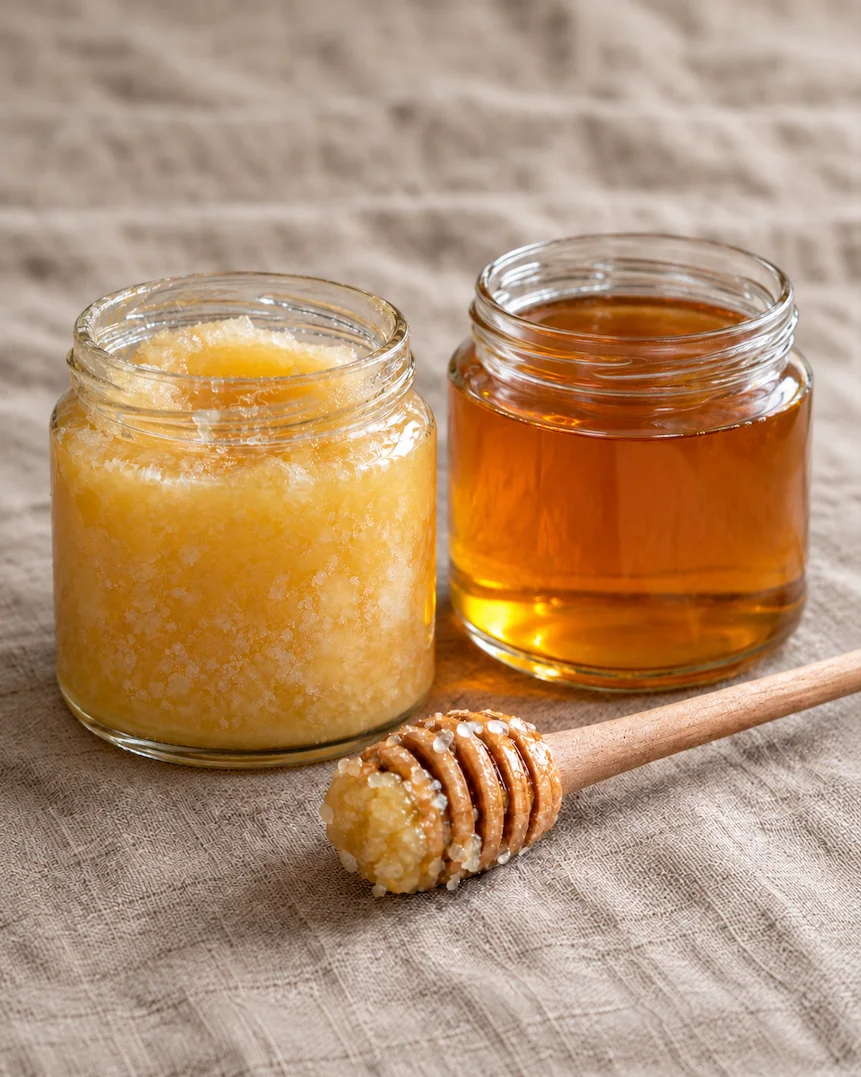
If you've ever reached for a jar of honey only to find it has turned thick, grainy and almost paste-like, you might have assumed something had gone wrong. Perhaps it had gone off, or was somehow inferior to the smooth, golden liquid you bought. In fact, the opposite is true. Crystallisation is one of the most natural things honey can do - and understanding why it happens will change the way you think about this remarkable product entirely.
What Is Crystallisation?
Honey is a supersaturated sugar solution. This means it contains more dissolved sugar than water can ordinarily hold in a stable state. The two primary sugars in honey are fructose and glucose, and it is the glucose that drives crystallisation. Being less soluble than fructose, glucose has a tendency to separate from the water content of honey and form crystals. As more glucose molecules join the growing crystal structure, the honey thickens, lightens in colour and takes on that characteristic opaque, grainy appearance.
This is not a defect. It is chemistry.
Why Does Some Honey Crystallise Faster Than Others?
The speed at which honey crystallises depends largely on its glucose-to-fructose ratio, which in turn reflects the nectar sources the bees were foraging. Oilseed rape honey, for example, can begin to set within days of extraction because of its exceptionally high glucose content. Acacia honey, on the other hand, is so rich in fructose that it can remain liquid for a year or more.
Here in Connemara, our bees forage across a diverse landscape of heather, wildflowers, clover and hedgerow plants. This variety produces a honey with a complex sugar profile, and crystallisation tends to happen gradually over weeks or months, resulting in a smooth, creamy set with a fine grain that spreads beautifully.
Temperature also plays a significant role. Honey crystallises most readily between 10°C and 15°C - which, as any Irish household will tell you, is more or less room temperature for a good part of the year. Storing honey at warmer temperatures will slow the process, while refrigeration, counterintuitively, can speed it up.
Is Crystallised Honey Still Good?
Absolutely. Crystallisation has no effect whatsoever on the nutritional value, flavour, or safety of honey. The enzymes, antioxidants, antimicrobial properties and natural sugars are all fully intact. Some people actually prefer crystallised honey - it is easier to spread, less likely to drip, and the texture can bring out subtler flavour notes that are sometimes masked in the liquid form.
The only thing that genuinely damages honey is heat. Warming honey above 40°C begins to degrade its enzymes and can drive off the volatile aromatic compounds responsible for its flavour. If you want to return crystallised honey to a liquid state, place the jar in a bowl of warm - not boiling - water and allow it to gently reliquefy. Never microwave it.
A Mark of Authenticity
There is a quiet irony in the fact that many commercial honeys are heat-treated and ultra-filtered specifically to delay crystallisation and keep them looking liquid and clear on supermarket shelves. This processing, while extending shelf life and improving appearance, strips away much of what makes raw honey valuable in the first place.
A honey that crystallises naturally is telling you something important - that it has not been heavily processed, that its pollen and natural compounds are largely intact, and that what you are holding is genuinely raw. At Mil Chonamara, we never heat our honey beyond hive temperature. If your jar has gone solid on you, take it as a sign that you have the real thing.
Embrace the Grain
Next time you find your honey has set, resist the urge to see it as a problem to be solved. Spread it thickly on warm soda bread, stir it into porridge, or eat it straight from the spoon. Crystallised honey has been enjoyed in this form for thousands of years - long before anyone thought to keep it artificially liquid.
It is honey doing exactly what honey does.
Mil Chonamara honey is produced in Connemara, Co. Galway, from our own hives and those of trusted local beekeepers. All of our honey is raw, unheated and minimally filtered.